Friday, August 26, 2022

2022 Gravel Worlds Race Report - 153 Mile Route

This past weekend was a race I have been aiming for since I did Steamboat Springs Gravel last year (Race Report) last year.  Up front on looking at last years results I was aiming for the podium in the 60+ age group and thought at around 9 hours I would have a good opportunity to accomplish that - and my time guess was pretty good - but more on that later.  A little about my gravel riding to prepare for this - well basically apart from racing I rarely ride gravel just based on my schedule and places to do so close by - so not much preparation:) Truth is most of my riding is done on my Stages Smart bike on Zwift.  May not be the best for improving my bike handling but sure is good for my time usage and from having ridden for 40+ years my basic skills are pretty good. I think in the last year since Steamboat I have ridden on gravel maybe 4 times before I got to Lincoln - Once at the Gravel Revival down in Tennessee and once while I was staying in Sandpoint Idaho and then a couple short rides near home.  The ride near home is only about maybe 2-3 miles of gravel with a steep downhill and then a steep uphill with a little flat between.  Usually I ride the downhill then go off and ride some roads then come back via the other uphill route.  I share this to say my gravel learning takes place at these races and while I am getting better at my bike handling it is not the best way to go fast.  I did get in a couple short rides in Lincoln before the race on parts of the course which was helpful to see the nature of the gravel in the area as ours out here in KY is often pretty rocky and technical while the gravel in the Lincoln area was pretty good if not a little soft with pea gravel and sand but not technical - well except when hitting the deeper sandy section at speed:)

From Pre-Ride the Day Before
My preparation for this race has mainly involved riding as many long rides as I can with many being done on the trainer - which while hard are only in the 4 hour range.  I did do a 200 miler (well it actually ended up being 195) this past March out in Solvang CA which was my longest distance ever - Ride Report - and longest time in the saddle.  I probably did 25 Centuries, most over 100,  in the last year but again maybe only 2-3 of them over 6 hours.  Also, other than Steamboat the longest gravel ride I did was last October at the Gravel Revival - link here for 2022 ride - at 60+ miles and it was more rocky gravel than the leg sapping sandy stuff in Nebraska.  Both are hard but in differing ways and handling is different as well.  

Also, this year I have added in more running including even doing a 50K running race at the end of June in So Cal that I got 2nd overall in and ran a 4:34:48  I added more running as I have some longer runs planned in the future that hopefully includes another R2R2R in the Spring of 2023.  I like to be able to run when I want and get to run with my grand-daughter which is fun so want to always be ready.  While the running does seem harder on my legs by working to run at least some each week - but usually not the week of a bike race - it is keeping those muscles used to the pounding.

Thus after all this I came to the Gavel-Worlds in shape but maybe not with the best gravel riding preparation.  All the way up to the race, since I have been focused on trying to podium in my age group, I kept thinking about the race and maybe that was a mistake but is my tendency being somewhat OCD which makes it hard to stop the focus.  I knew the hills were going to be there and had done a good ride at the Horsey Hundred in Lexington which in riding the 100 miler and then the 26 miler had 8000+ in climbing that was a lot of rolling hills.  I was thinking I could ride at a good pace at Gravel Worlds as I rode solo at the Horsey Hundred and averaged around 19.2mph.  What I had not allowed for, but deep down knew, was how much the gravel would slow me down on the uphills and affect how fast I could go downhill.  Then there is that there were way more hills in Lincoln - they were relentless. While I did get a max speed of 38.5mph on one of the downhills at Gravel Worlds most were not as fast as I could do at Horsey Hundred as I was not sure of myself in the slippy gravel.  Even tracks I got into that were smooth and fast would then disappear and then had to change tracks which was exciting to say the least.  I was probably going 30+ on one downhill when I hit some deep gravel and was grateful not to biff it as my bike got a little sideways but pulled it in and saved it.  I could tell that while I tried to focus not simply clinging on for dear life to the bars and instead holding the front end a little more loosely to let it float I still held on too tight as I got blisters in my palms.

One of the hard parts of these long races for me is the mental side early on of knowing just how long I have to go.  In these races with 400+ riders on the longer courses it is important to get out with a group, as gaps can happen quickly, so as to be able to get some drafting effect and also make the initial miles go by faster mentally.  I was able to do this but took longer than necessary as I was a little skeptical about how fast to go as it was a little dark at the start for maybe the first 20-30 minutes as had to use lights.  Had a little group going  till about 45 miles and then broke up a little and then stayed with those I was with till the first checkpoint at 60 where I refilled my water.  It was there I lost the group I was with as was not sure where they were.  Ended up with another group that  caught me and I stayed with them till about 115 when they slowed for a mechanical so kept going to the next aid station at 128 miles.  As I was leaving they were coming into the aid station and as I was feeling a little tired and knew once they got done they would be moving along quickly as a group, and there was a big guy with them that was just a beast as he pulled pretty hard.  My plan was to ride at a good pace but not too hard as knew they would catch me and I did not want to be too tired when they did.  As I figured the 5 people in the group caught me with about 12 miles to go so I just latched on.  Did get a little worried with about 7 miles to go as I got an inner left thigh cramp then my right hamstring cramped. sign my electrolytes may have not been on point.  Just as I was getting dropped it faded and I got back on and this happened a few times but thankfully stayed with them to the end and finished in 9:43:21.  About 45 minutes slower than planned but all things considered a good ride and with 11,400+ feet of climbing as good pace.  Figuring with my moving time of 9:32:52 I also seemed to do good at stops, 4 of them, as had one nature break early, one water refill stop at about 90 and the two checkpoint stops at 60 and 128 and all those only took me just over 10 minutes.
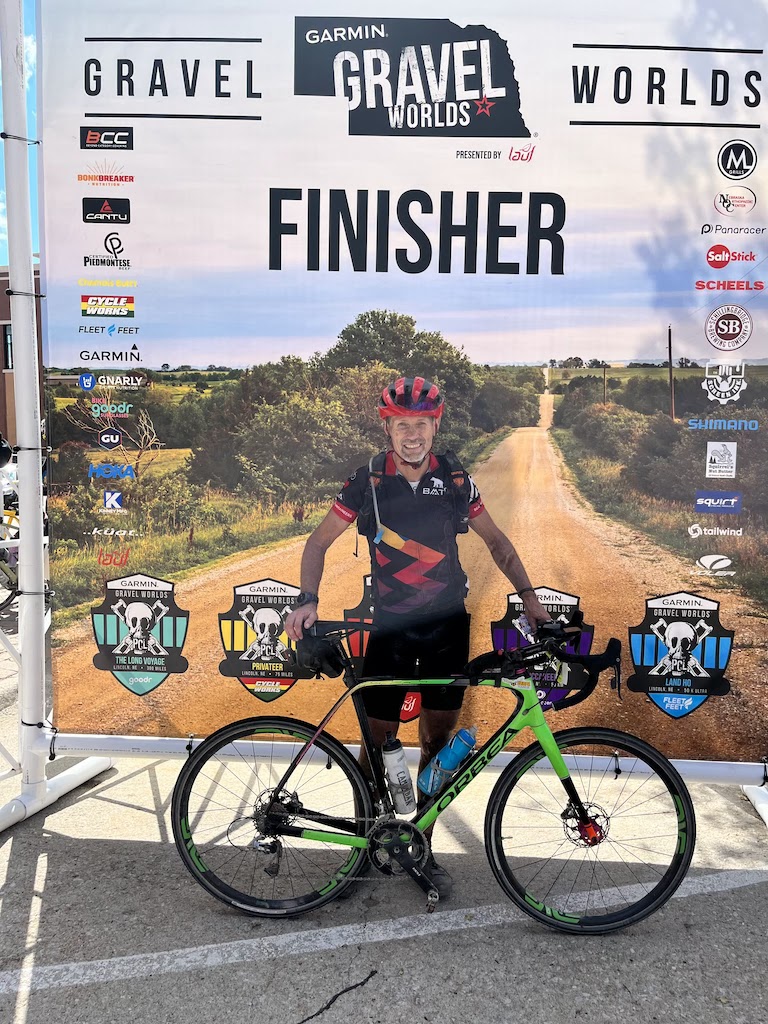
My official time, again, was 9:43:21 and my placing I was 139th overall out of 435 and 6th in the 60+ AG.  The wining time for the 60+ was 8:58:42 with 2nd at 9:04:27 - so about 40-45 minutes ahead.  3rd was at 9:27:33 which was only just under 16 minutes head so I was not too far behind and my guess that it would take about 9 hours to win was about right.  In looking at the splits the leaders were about 6-7 minutes ahead of me by 60 miles and opened it up from there.  The third place guy was 17 minutes ahead at 100 miles so stayed about the same the rest of the way.  I need to get out a little quicker to get with the faster pace line and leaders.  The danger in a pace line - especially early on when just getting warmed up is you can get comfortable in one that may be a good pace but a little slower than you need.  There is also the danger of gong too fast so a fine line to ride.  It is hard in these races as you never know who you are racing so you just go and then if not careful can go too hard at the start.  Overall I am happy with the race as no crashes and kept a fair pace the whole way.  Can I go faster, I think so and each gravel race I do makes me a better bike handler so they all add up to being more efficient each time I race.  Not sure I will ever have the time to, well till I retire in maybe 4 years, do much gravel riding so races will be the place to learn.  Will I ride this race again next year - right now I want to but have to see how my schedule works out and what else is out there.  At Gravel Worlds they have The Double where you run a 50K on Friday then do the 153 ride on Saturday so may go for that.  It will make getting on the podium more difficult but one of my goals and purposes in doing what I do is to show what can be done even as one heads into there 60’s and The Double would do that.

My fueling is below but the basic plan was to have two 24oz bottles with the “special mixture” with lots of ice so can sip on them for the whole race and then the backpack would have plain water.  I carried 8 gels (SIS and PowerGel), used 6, and some S!Caps and some Bit-O-Honey, never got to these during the ride as could not get them open, as well as Vespa Ultra Concentrate (1 Vespa CV25).  Stopped three times to refill/top off my water and did so at 60, 90 and 128 miles.  Only took in some extra stuff at the checkpoint at 128 miles where I had a half a can of coke - funny did not give its usual jolt this time but probably did more than I realized at the time.  As usual no stomach issues and no bonking.  Yea my legs
were getting tired but that is natural and not a bonk.  I did get some cramping as my plan had been to take in 2 S!Caps every two hours but had some issues getting to them and out of the bag they were in so I missed at least one round of them.  Also, in past races I have used Tailwind which has some electrolytes and did not this time so did not get those electrolytes thus may have been a little low on them in missing my S!Caps.  My fueling plan I figured out with Peter at Vespa did work as, again, did not bonk but after this race realized some more variables.  At Steamboat there were far more paved roads so more time to dig out the fuel but not in this ride.  Also, stopped more at Steamboat so if I stop less I have to account for how I fuel and actually being able to get to what I had planned to take in.  Again, the actual intake for the Pre and during ride is below.

Lastly, let me re-iterate what I have shared before and that is not only does OFM work for race fueling it also helps with recovery as there is less oxidative damage done during the race.  While I did not ride or run the day after the race as had to drive home I did go for a run two days later and for the week after got in some good runs and a couple rides.  While I was tired - sorta natural for the effort, the most sore thing on my was my butt:). I felt good enough I had to be conscious to take it easy and not ride my usual and to hold back on some runs.  Bottom line OFM WORKS.

Lessons Learned
  • Need to be more aware of pace early on and push a little harder but not redline
  • Due to the difficulty, at least for me, to get to some fueling out of my pack I  may need to use more Tailwind - also helps with electrolytes
  • Inline with this I have to think about gloves as I like to wear full fingered ones as just nice if crash but they do make it hard to open fuel and even feel for it in ones pack when it settles down farther than you thought it would:)
  • Need to think about if my Carb intake is good.  I was at about 24gr/hr but in looking at some others, like Jeff Browning who does Ultras running and is fat adapted he is closer to 40 or so.  May not need more but need to look into it.  The effort in cycling is not the same as running as it is more up and down, literally in this race, for effort while when I run it is more often constant
  • Need to work on shorter hills for gravel as for sure different than when did Steamboat that was similar overall elevation, a little less, but longer.  The hills in Lincoln were relentless
  • Continue to learn to not hold so tight to the bars 
  • Ride more gravel
  • Need a new saddle as the one I has again was not great for this long a ride
Lastly I want to thank the following people:
  • God for instilling in me the desire to do what I do for His glory and the ability to do it
  • My wife for putting up with my riding and running
  • Peter Defty at Vespa
  • Sam Torres & John Switow - great friends and encouragements
  • Scott Hess at The Spoke Easy Bike shop in Campbellsville KY who saved my but just before I left with fixing my bike
  • All the riders in the BMTR group on FB/Strava for the great rides together
  • All the riders on Strava who were also a great encouragement
  • All the other OFM athletes on the Vespa Team who each show what can be done when fat adapted
  • I am sure I forgot someone but there were many more - thank you

Strava Data - Gravel Worlds

Gravel Worlds Route:

Equipment
  • Bike: Orbea Terra - W/SRAM Red 2X 
  • Enve G23 Wheels W/Panaracer Gravel King SS+ 700 X 38 types
  • Orange Mud Endurance Pack V2 w/2ltr bladder & 2 X 24oz Bottles on Bike

Fueling:
Pre-Race
  • 20oz Modified BP Coffee
  • 1/2 Cup Oatmeal with Butter and Brown Sugar
  • 2ea - 50mg Vitamin D
  • 2 GLPC
1/2 Hour before race
  • 1- Vespa CV25
  • 1- Tru-Niagen
  • 1ea Bit-O-Honey at 20 and 10 Minutes Before Race
Prior to Race Totals
  • Calories - 786
  • Protein - 26
  • Carbs - 58 g
  • Fat - 50 g
During Race:
  • 4ea - 24oz Water Bottles
  • In the bottles I had the following special mixture in 2 of them to start.  Idea was to start sipping on them at 90 minutes then use one for first half and other for second half but not sure I actually used all of the second on
  • 1ea - Tru-Niagen Powder
  • 3 - Tbsp Liquid L-Carnitine
  • 1 - Vespa CV25
  • 1/3 Scoop Keto Fuel
  • Added water and ice
  • Carried one 2 Liter Bladder and topped off twice
  • 3ea - Vespa Ultra Concentrate
  • 1ea - Vespa CV25
  • 6ea S!Caps - 2ea at 2, 4 and 6 hours
  • 3ea of SIS Go Energy
  • 3ea of PowerGEL W/Sodium
  • 1/2 Can Coke at 128 mile checkpoint
  • 1/2 a hot dog - more like a sausage - at the 128 check point, not sure why I ate it but looked good and salt sounded good
During Race Total
  • Calories - 921
  • Carbs - 224
  • Protein - 3 g
  • Fat - 6g

Monday, July 25, 2022

Faith and Fitness

Now, I get it that some may have a hard time getting past the title and if that is you I ask you to read though it as while I see what is to follow as a call from God it is also a call for all to take care of the body you have.

Those that know me know that faith is important to me and I try to let it lead what I say and do – yea I often fail but that does not mean I do not seek my faith to inform my actions.  One area that I am often asked about, mostly by those with little to no interest in fitness, is if I should workout as much as I do as it might interfere with my calling of God.  Often I think this questions stems from a misunderstanding of vocation, or calling, as cannot God call us to any number of activities with the goal of His glory being in all those actions.

 While 1 Cor 9:24-27 applies to much more than simply the physical it is also not limited to the spiritual as far too many professing believers seem to think that our bodies are temporary so are to be taken as they are with little thought put into how we treat them.  But this could not be further from the truth.  While God has us here we are to care for/steward our physical bodies as well as nurture the spiritual side of things

I started reading Ben Greenfield’s book Endure and he mentions a verse that I often see greatly misinterpreted/misrepresented, not by Ben, when it comes to Christians and fitness and prompted this post:  

1 Tim 4:8-9 says:  “for while bodily training is of some value, godliness is of value in every way, as it holds promise for the present life and also for the life to come. The saying is trustworthy and deserving of full acceptance.

 Now some use this verse to somehow say that to workout and get in shape is of no use as we are to spend all of our time, or at least implying this, in spiritual endeavors.  Now to be honest I hear this mostly from those who do little to nothing to better, or even maintain, one’s health.  The problem is that this passage does not minimize training ones body but instead uses what I call hyperbolic comparison - that is it is saying that in comparison to seeking godliness training ones body is of little value.  This is much like Matt 10:37 that says basically if ones loves their father or mother more than Christ they are not worthy of Christ.  This again is simply saying one is to love Christ supremely when in comparison to others things one loves.  It is not saying to hate ones father and mother but simply to love Christ even more in comparison.

 So it is with training ones body - we are not to do so at the expense of spiritual growth and are to make sure we see the lasting value of spiritual growth.  However, at the same time we are to also train our bodies and care for them as the stewards of them we are called to be by God – one of the callings we all have.  Remember the better shape we are in the more use we can be in the hands of God.  If we are restricted by bad health or reliant on medication our usefulness may be minimized.  I am not saying one with bad health, or some infirmity, cannot be used by God – they can and often are mightily – but that we are to do all we can to be in the best shape we can to be able to be used in more ways by God for His glory.

 Truth is Paul in his writings is often dealing with the hyper focus of the Romans on sport and training.  The reality is that the normal/average every day citizen probably needed little training to be fit as the basic act of living in the first century would, in comparison to today, itself be training.  I doubt that obesity was an issue for those in the first century, and for many up to even the resent past, unless, one was wealthy.  I would go as far as to say it is incumbent on Christians to care for the body God gave them as best as can be done so that it, and you, can be used by God in whatever manner He desires, when He desires.  How many professing believers out there that scoff at this could spread God’s word as Paul did by traveling as he did without the aid of a car or other motorized transportation.  If tomorrow as a believer you lost everything and had to do manual labor to grow your own food and had to travel by foot or bike could you do that or would you be at the whim of those in power.  I know, sadly, many pastors that could not due to not taking care of themselves - often in the name of doing God’s work but in the end would be limited in the work God could have for them.

 Well, the work God has for us extends to many areas - no - it extends to all areas - of life as was said by Abraham Kuyper and I know this was more in reference to interacting with the world but by extension can be applied to our bodies -  ““There is not a square inch in the whole domain of our human existence over which Christ, who is Sovereign over all, does not cry, Mine!

 So, my encouragement to you if you are a believer and have Jesus as your Lord and Savior is to not neglect your body and think that to do so is some sort of super spiritual endeavor.  Sure, do not let “fitness” take over your life at the expense of time with God but work to do both as both are required.  In these strange times we are in I am more and more convinced that the more healthy we are as believers as the world slips into a pharmaceutical haze the more those of us that do what we can do to avoid this will be there when we are needed.  

 Start today - go for a walk, a ride or a run and use your time wisely - listen to your Bible on tape, listen to sermons, listen to books on audio and even more so meditate on God’s working in your life.  But above all get moving.  I may not always do this but often I get in more thinking on a run or a ride than I do when just sitting still.  I know I need to learn to just be still but the way my brains wired I think more about things as I am active - so I try and do both.

 This principle of caring for the body also applies to how one eats – what one puts into it.  I have heard more than one person misuse the following verse to say whatever one eats is fine if eaten in faith but this is not what is being said.  

 1 Tim 4:4-5 says: “For everything created by God is good, and nothing is to be rejected if it is received with thanksgiving,  for it is made holy by the word of God and prayer.” 

No this is saying to be thankful for what one has and was dealing with dietary restrictions from a religious perspective.  There is no way this verse is saying if you eat Oreos, or endless stacks of donuts, as a normal occurrence/choice, that if done by faith you are fine.  Sure, if you were in a place where all you had to eat was such then that is a different matter but for most the choice of what to eat is just that – a choice.  Choose wisely and choose what will most lead to better health and the avoidance of pills, potions and pokes. Do not take the life you are given lightly but see it as the gift of God it is – even if it does not do all you may like it to do.  Our call is to be good stewards of what God gives us and let us seek to do that.

Do not forsake the body God gave you to steward for some over spiritualized , at the neglect of the physical, view of life.  Don’t fall for the Gnostic heresy that the writers of the NT faced that separated the spiritual from the physical.  No, deal with both and grow closer to God in the process.  Seek out God’s guidance in how you need to proceed and seek to be the most useful tool in the hands of God you can be.  Be a faithful steward and do so not to win a race but to glorify God.  Now you may win races – nothing wrong with that – but even that is to be done to give God glory.  To take the stewardship of our bodies lightly is to make light of what God has given us.

 Start today and if you need help reach out to those you know that see things this way or you can reach out to me.


Monday, June 27, 2022

2022 Orange Curtain 50K Race Report

Let me start by saying this is not the optimal way to train for a 50K, or more - well for most people - that is running about 20-25 miles a week, often less, with my longest run being 14 miles since I did a R2R2R almost 2 years ago.  Even then not much in the way of long runs as my last marathon was about over 3 years ago and my last Ultra was at Run Under the Stars 4 years ago.  That said I can also say I have been about the most injury free, but for a sore hamstring about a year ago, in the last 2 years than I have been in some time so while not optimal my training met one major criteria - stay injury free.

The Orange Curtain Race has a lot of distances to choose from and all run on the same loop.  They offer the following - 100K, 24 HR, 12 HR, 50K, Marathon and 10K.  It is also a basically flat course on the San Gabriel River Trail with the only rises mainly being 3 place where you go under a main road on the trail.  It is paved asphalt with a dirt siding for most of it which I used at the end to save my legs some.  Thus it is a good place for fast times.  Maybe the one thing that I find hard is the receptive nature does play with your head as there is a place to drop out every 10K:)

Here is my Strava data for the race - for sure see the slowing down in the mile splits:) Orange Curtain 50K

I went into this race knowing I was in goodish shape for maybe 13 miles based on some recent runs and a few weeks over 30+ miles but had no idea how I would do once I got past a half marathon.  Only signed up for this race about a month before as it fit into my schedule and figured it would be a good place to test my foot to see how it would do.  So, I put the race on the schedule having no idea how things would go and not much time to prepare so instead of changing much I still rode a lot and ran enough to “think” I could do this.  Even did a 120 mile ride two weeks before the run and a 110 mile ride the week before.

As race day approached it was clear it would be hot but how hot and when would it heat up was not as clear.  Race day came and it was about 60F to start with the usual humidity, but not Kentucky humidity, you get in the early mornings here in So Cal.  My plan, and I knew this could backfire, was to go out with the leader as long as it was no faster than 7:40 pace and then just see how it went.  I had a good idea that probably around the 3rd lap (race was 5 - 10K laps that were out and backs on the San Gabriel River Trail) which was about19 miles I might have issues.  Not so much with fatigue in the overall sense but muscle fatigue from the pounding of running for that long which I was not used to. 

The race started at 6:30am and I went with the lead guy, Paul Gesl who got 2nd the year before in 4:19, at a pace that seemed comfortable at around 7:45 to 7:55 min/mile and HR was at 134 - 137 for first 7 miles.  I was with leader for first two laps and then on start of the third lap came out of the aid station slow from filling my water bottle and was a little behind him and thought about catching up quickly but realized that was not wise as would need to pick things up too much.  Thus I stayed pretty even with the leader till about half way reached in 2:03+ and then I started to feel it in my legs as my pace went from under to just over 8:00 and slowed more from there so was quite a bit behind by end of the third lap and also had a very slow aid station stop at the end of the third lap.  From there the run was a matter of finishing as my legs were feeling really beat and I felt my hamstring tighten a few times so goal was to maintain so as to not walk and finish.  Thus pace started being at 9:00 - 10:00 but just kept plugging along.  Being an out and back loop course it was sure inviting to stop and call it a day but I knew I would regret doing so and just kept plugging along.  As there were other race distances going on and one person came by me I was not sure if he was in the marathon or if I was still in second - turned out he was in the marathon.  Thought about picking up the pace near the end, I repeat I THOUGHT about it, but kept feeling a little tightness in my hamstring so thought better of it.

I finished the race in 2nd overall and 1st in the 60-69 AG in 4:34:48.  For sure the last half was very much slower but think it would have been slower no matter how much slower I went out as the soreness was that which I feel just from time on my feet.  The temp started to warm up after the halfway and I think it was about 85F, or so, when got done.  Man did my legs hurt when done as felt like my legs were rocks and could not sit down without help getting up.  Feet were sore as well and had my usual soreness on top of my foot from tying my shoes too tight.  But at the finish did not feel any blisters but figured I probably had some and found I did later.  

I am writing this a day  or so after the race and while still sore it is very much better than it was.  Will still take a few days off running but try and get a ride in to loosen up the legs on Monday.  The blisters I got and usual toenail issues are what I get from having narrower feet.  Most people would get a 1/2 size larger shoe but I cannot as then they just fall of as cannot tighten them enough.  One very good thing about this is my right foot that in the past hurt for weeks after such a run was pretty much back to normal a day after the run except for blisters so that is a big win and one of the things I was testing out.  With no running races till Labor Day, Mt. Baldy race win So Cal, I can keep running to a minimum for a week or two to let my legs recover. This works out as I now need to get ready for Gravel Worlds (155 miles with 11K of Vert) gravel race in Nebraska come the end of August.  Then I go from there to get ready for the Mt. Baldy run Labor Day and then the Bourbon Chase Relay the end of September.

As far as fueling I think things went OK - no bonking on essentially very few calories.  In looking back I do not think I got enough Electrolytes as only then in S!Caps and one Gu Roctane but no more and think, no I know,  I needed more.  Plan was to carry plain water so could pour on my head, which was good, and go with Gels but due to this did not get a constant feed, including electrolytes, as is normal when using Tailwind.  Had planned on a Gel each lap after the start but realized when done I only took two them.  Also, did not use my usual Bit-O-Honey as my sinuses were draining and giving me problems and I have learned that eating and running when this happens does not go well so did not use them.  A lot easier to get by with this when riding.  Again, probably could have used a few more carbs as well with the pace I was at but not too much - if I had taken the total of 4 planned I would have been good.  My fueling is below at the bottom of the report.

Kit for the Race:

Lessons learned:

  • My general training plan of riding more does work but to race longer races running I need to get in a few more long runs just to get the muscle memory so as not to pound my legs as much
  • I need to work on getting in more electrolytes as I think some of my hamstring cramps could come from that - even though I know a majority comes simply from not having run that far.
  • This did let me know I can be comfortable at sub 8:00 pace and with more training can extend that out to 50K
  • To get ready for next years R2R2R I will need a few more longer runs and more trail running to get my legs accustomed to the terrain

At the end of the day while I went in wanting to run from 4:10 - 4:20 and missed that I am encouraged when I look at things realistically.  As I often say I did not get the race I wanted but did get the race I was ready for.  

Here is the fueling for Pre-Race and During:

Before Run:
  • 20oz - Modified BP Coffee
  • 1 packet - Instant Oatmeal with 1 tbsp Heavy Cream
  • 1 Vespa C25 - 30 minutes before Race - Did 2 mile warmup after this
  • 1 Vespa C25 - Right before race
Total Cals - 832
  • Protein - 33.5 g
  • Carbs - 49.5 g
  • Fat - 55 g

During Race
  • 4ea - 20oz bottles of water
  • 1 - Gu Naked Gel (@ about 1 hour)
  • 2 - Vespa C25 (1 at 2 hours & 1 at 3 hours)
  • 1 - Gu Roctane Gell (@ about 2.5 Hrs)
  • 4 - S!Caps (2 @ 2 hrs and 2 @ 3hra)
  • 2 - Small cups of coke  (1 at about 22 miles and 1 at 28 miles)
Total Cals - 290
  • Protein - 0 g
  • Carbs - 68 g
  • Fat - 0 g
#VespaAthlete
#VespaPowerProducts
#FatAsFuel

Saturday, April 16, 2022

How are we to View Elite Athletes with Regards to Training and Racing


I needed to get back to writing so to start this off I want to deal with an issue I see often put forth and that is taking the training done by elite athletes and applying it to the rest of us.  When I say the rest of us I mean from the beginner to the more advanced athlete who does not, for the most part, make a living from the sport they participate in.  But just so you know where I come from since some may not read to the end – I am not anti-learn from elites, not anti-science and not anti-technology.  What I am I one that wants people to understand who they are so they correctly apply experience, science and other aspects of training to themselves and not blindly do what is often put forth as “The Way.”

 Another subject I will cover in more depth at a later time is fat adaption (OFM) but I mention it here as there is a cross over with elite athlete training – specifically endurance elite athletes.   Often the argument those in a carb-centric world use to denigrate fat adaption is to point to the success of elite endurance athletes who most often rely heavily on carbs, it is the paradigm that has been around for some time, as a fuel source for events and consume large quantities of carbs on a daily basis.  First, one needs to realize simply because an athlete is “elite” it does not mean they are healthy – in fact many are on the verge of sickness, or susceptible to sickness, as they push the envelope and diet can greatly attribute to this issue. 

 Then is the need to realize that simply because an athlete performs well on a carb-centric diet does not mean they could not benefit, health and performance wise, from being fat adapted but for many elite athletes it is not feasible to transition since it does take time, even though there are ways to transition that can minimize issues during transition, as most cannot afford the needed time to do this as sponsorship relies on results and the risk of less than optimum results is not acceptable to most.  In this mix is to also realize many elite athletes have nutrition sponsors who are carb focused and to move from them would mean the loss of monetary and other support.

 Let me add here that I often see, as an argument for high carb as best, is to speak of Kenyan and Ethiopian runners who have a high, actually very high, carbohydrate diet.  Two things here, first is that many Kenyans just based on lifestyle do a form of fasted workouts as they often run early before eating and thus while maybe not optimal do work on fat adaption to some extent.  But, secondly, and most importantly, is to realize this is simply how they eat as they eat what is available and then add to this their general lifestyle you get a picture of people who look much different from the people who are seeking to do as the Kenyans.  Most simply see carbs as carbs but they eat different than most and add in a lifestyle that is more spartan and active you see a different picture of which most will not copy.  This is a case of a people who do well functioning on the diet they have available and to take that diet as is usually will not end well.  I have actually seen where many Africans that come to the US and begin to eat s we do end up not doing well as the foods they eat do not function as those they ate at home – carbs are not all equal.

 Next is to realize many elites hold their protocols tight to the chest – at least their coaches do – and you cannot believe all you hear.  Not that they are lying but that the whole picture may not be seen or shared.  I remember back when I ran in college the stories of how many miles people ran was all over the place as some spoke of high milage that led to their success while others of how little they ran.  Often the high milage guys did not share how fast they ran as much was done slower and those that ran less often left out such things as warmup and cool down and focused on the main workout.  All this to say what you hear is not always exactly what takes place.

 Let me say that we can indeed learn from elite athletes, and should, but to emulate them without a good deal of discernment that takes into account your differences to them is a different matter.  This is akin to car companies using, say, F1 as a testing ground for car technology and design.  These car companies do not simply copy over the technology from F1, or other racing, but adapt and modify it to meet the needs of the everyday driver.  This is how we should view the elites and learn from them – take principles and adapt them in a reasonable and responsible manner.  What the elite athlete does should not be used by coaches as a blanket support for what they teach.  I have always liked the Lydiard method, and am a certified coach, as taught since it uses his principles but applies them in a one on one basis to the individual.

 The other issue, and truly the main one I have already mentioned, is that we are all different and while there are indeed principles that may cover most people we have to factor in our differences as we are, again, in the end an experiment of n=1.  Matter of fact this is even true of elites since they should not blindly copy other elites who have had some success but need to realize their uniqueness and adapt principles just like the rest of us do.  Now they, elites, may have more they can adapt from one another but they still need to use great care in how they utilize what they learn from others. This adapting does take work as it is much easier to see what one person does and copy it but that in most cases will end badly or at best not help one achieve the best results.  What we need to do is make sure we do not just gloss over the training and generalize it but look at the person, their environment, background, history., health and much more.  This is what we should do in any study as we need to see not only how one ticks but what makes them tick and keeps them ticking.  From this we will get some principles of their training but then even that needs to be looked at more closely.  

 Another thing to think about is that simply because an athlete does well you should ask could they do better.  I once heard, and this is not a comment on veganism, a vegan actually ask the question of themselves as to whether if they changed their diet they would be better and they gave an honest answer as they said something like “maybe so” but they saw the philosophy behind veganism more important than performance – kudos to that answer.  I share this as far too often blindly following what others who get the publicity do without asking serious questions so as to make the correct choices is most often not the best decision.

I mentioned this before but before you decide to emulate an elite you feel you need to emulate please realize that elite athletes are often on the edge, if not over it, of not being healthy.  Simply because a particular rider or runner does not well does not mean it is sustainable and certainly for the non-elite it most often is not.  It is interesting how many really good athletes I have known over my 47+ years running and 40+ years riding that no longer run or ride.  Sure there are some that do but a large number do not.  Often this is simply due to the fact the elite lifestyle with regards to diet and training takes one to the edge and going over that edge a number of times takes its toll.  I know that while I was never elite I did ride and run with a lot of people who were and at least with running I paid the price with injuries, some that I still have.  Thankfully I saw this coming and took up riding which I credit for saving my body so I could run and ride for the long term.

 Let me leave this with you from one who is still at it into his mid 60’s – I will be 63 this year – a long term focus is much better than a short term one for most of us.  Sure if you are elite and willing to push the envelope as your profession that is a decision you need to make.  However for most of us we simply need to take a long term look at life.  Spend more time learning how “YOUR” body works and how others like you function and work to better your self.  Learn principles from the elite athletes you follow but be honest and see how you are different.  Not to minimize yourself in comparison but in truth in the end maximize your potential.

Wednesday, March 23, 2022

Solvang Double Century Report

This past weekend I did my longest ride to data - distance and time - in doing the Solvang Double Century, well actually it needed up being 195 miles.  I went into this having done a number of 100 plus mile rides and doing Steamboat Gravel (142 miles/9,5 hours) last year.  The ride in Solvang ended up being 10:56 moving time, last miles - including descents - in the dark with lights, but with all the flats our group got - 2 for me - and aid station stops the actual time we were out there was 13: 28 - so a long day.


Here is the Strava Info: https://www.strava.com/activities/6851455114


Relive 'Solvang “Almost” Double Century'


To add to this the last half was quite wet and I even got probably close to hyperthermic as got a flat in the last 15 miles or so going up hill and with being wet and sweating on the descent I really started to shake.  Thankfully there was a climb ahead - yes I said thankfully - as it allowed me to warmup up and there was only one other faster descent I got cold on to the point of shaking but just finished up cold and wet and in the dark - why I did not go back out and do an extra 5 miles which now, and I knew I would think this - should have done to get the actual 200 miles.  But is was the design made on the spot.


For this ride I had talked to Peter about using more carbs as all my training rides have been very very low fueled as use them for working on my fat adaptation / metabolic capacity but for this, as was longer, and with a group that would probably make at least the start faster I wanted to take in more carbs along the way to keep good supply of energy.  Also the way the course was it was more front and back loaded with climbing and as my bike is an 89” Medici Strada with old school gearing (53X39 Frt and 12-24 & speed rear) climbing was not a simple spin up the hill.  I wanted to make sure I had good energy to climb in the gearing I had ALL day and not just at the start.  Have to say I was happy with how the climbing went as did not use the 24 but went no smaller than the 21 to save my 24 for a bailout gear but did not use it.


The plan was to do my usual pre-ride fueling of a modified BP Coffee (Coffee, Butter, Coconut Oil, 85% Chocolate Square, Egg, Collagen & Coconut Creamer) and a 1/2 Cup of Oatmeal) then 1/2 hour before ride take one Vespa and one packet of Tru-Niagen.  


Pre-Ride Intake:

  • Calories: 686.8
  • Fat:  36.7 g
  • Protein: 33.8 g
  • Net Carbs: 48.6 g

During the ride the plan was to take a Vespa every 2 hours along with a couple S!Caps and then in my first two 24oz water bottles use SFuels Train in one and Skratch in the other then as I refill use Tailwind,  from the single serve tubes but use half a tube per bottle.  I also carried some Jolly Ranchers to suck on and some gummy beaked Flavor,ars as these give a slow flow of simple carbs and for me no big spike and crash and do not take many of them.  Apart from this I would snack at the 5 aid stations - I think that was the count - and not gorge on anything but just take what I feel like taking.


The forecast for the ride was rain and cooler temps so need to make sure energy was up as body would use energy to keep the body warm as well as for riding.  I had to go back and think about what I snacked on at the aid stations but think I pretty much covered it all - if not in order - in the screen shot from Cronometer, the program I use when figuring how much intake I had.  I did realize that I did not use as much Tailwind as planned since I did not drink as much as planned due to being cooler.  I usually just use the Vespa CV 25 pouches and did so for 3 of them but wanted to try the smaller and more portable Vespa Concentrate packets and they worked great as just downed on then washed down with water - these will be my go to for longer rides as it greatly reduces what I have to carry.   Here is the over all intake for the ride that again consisted of 10:58 of riding with total time of 13:28:


Ride Fueling

  • Calories: 1444
  • Fat: 51.4 g
  • Protein: 33.6 g
  • Net Carbs: 215 g


As far as the ride it was a great day out if not a little soggy.  The only bummer was the number of flats our group had with about 5-6 of them and I had two of those.  This made the day longer and reduced the number fo finishers as we had to complete the ride in the dark.  I had no energy lags and no bonk so the intake seemed about right for the day.  I did a have a few mental issues early on when thinking about how far there was to go.  Quite the realization when you get to 100 miles and realize you have the amount left you usually do on a weekend.  These times did not last long and is the best part about riding with a group.  


This was an important ride in my preparation for Gravel-Worlds in August that takes place in Nebraska and is 155 or so miles with 11,000 ft of climbing.  I know that I can ride the distance and as we did have some harder sections - a couple catching back on after flats - it will help mentally in August.  


Between relying on fast for most my energy needs and the use of Vespa my post ride recovery was very good.  Sure I was tired but after driving 3 hours back to LA on Sunday morning I was able to run 5 miles a a good pace.  Then the next three days I rode 50, 30 and 40 miles.  Again, did feel tired but for sure the recovery was much better than back in my carb centric days. The rest of this week I will do at most a couple runs and then travel home.


Bottom line - I can not recommend Vespa enough  - when used in conjunction with being fat adapted - or just getting to that point -  it is the way to go.  Check out the posts here for more info on OFM - https://ofm.io/blog/

Tuesday, August 24, 2021

10 Buck Bike Club

 I have recently joined the 10 Buck Bike Club and am on the advisory board.

So what is 10 Buck Bike Club - Glad you asked:

First, We are a website/club that is all about bikes.  There are no ads, no selling of information and no tracking of what you do.  No, this is about you and as we gain members and grow so does the site and the benefits to you.

Second, it cost $10/year, thus the name - about the cost of a couple Lattes

Third, instead of ads, remember we have none, we offer Member Perks and Discounts and as we grow we will work for more of these.  Hey who does not like to save as cycling is far from an inexpensive sport.

Also, along with news and a live feed for conversations, we have a number of groups covering everything from Bike Fit, Bike Repair to Gravel (one I lead), Multisport, Technology, Training and much more. 

We are also looking to add Webinars and Workshops on a number of topics all related to cycling.

Lastly, if you are looking to find a place to host your cycling group you can do that here as well.

Come on board and help us grow and as we grow we all benefit from each other.

If you join please use my name as it is good to see the different avenues the members get to the site from.


Sunday, August 22, 2021

2021 Steamboat Springs Gravel Race Report

Ok it has been some time since I have put up a blog post – a very long time - and I have moved from my old site (Bluegrass-Runner) that focused primarily on running to the new site where I will cover all things endurance, including nutrition.

It has just has been one of those times where work and life coupled with just not feeling it when it comes to writing all coalesced and I just did not post anything.  I thought having just finished the Steamboat Springs Gravel race on August 15, 2021 it was a good place to start and I hope to be more consistent on future posts.  So here goes.

In truth as I write this my initial plan had been to do the Gravel-Worlds this weekend (Aug 21, 2021) but when the Rona hit and there was no racing in 2020 I had to defer my Steamboat race so am hoping to do Gravel-Worlds next year.  So after probably getting the best base I could have, as not much racing, I headed off to Steamboat.  The plan was to get there midday Friday, do a short ride Saturday and do the whole Expo thing and then race Sunday.

Got to Steamboat early enough Friday to do a short ride to town from the hotel and got in about 10+ miles including a trip out to Moots Cycles and a tour of the facility.  Interesting part is back in around 1983 I raced the Steamboat Springs Stage race, road bikes, and visited the original location of Moots, now Orange Peel Bikes, and had not been back to Steamboat since then.  After the ride I went looking for a steak and found Steamboat is not a cheap place but fortunately my room had a stove so was able to save some money by getting a nice rib-eye from the store and cooking it in the room.  Saturday I went out for a 30+ mile ride and did not realize till the race I was doing part of the course backwards.  I did notice on the ride that if I pushed too hard I felt the altitude.  Probably compounded by my Exercise Induced Asthma (EIA) that with the dry air is not very altitude friendly but it is what it is.  Was a nice ride and saw many others out doing the same thing.  On the way back from the ride I went to town to pick up my number and scan the expo but as was coming back later did not spend a lot of time there.  After resting up some I went back to the Expo and checked out what was there then was time to go back to the room to get ready for race day.

Race day was cool but really not bad at 50F or so.  As I was going to the start from the hotel I took a gillette and arm warmers and would just put them in the Orange Mud pack I use before the race.  I did not want to carry the stuff but it did not weight much and who knows if a freak storm came in I would be ready, it did not but I was ready.  I had packed my bike with 2 - 20oz water bottles – one with SFuels Train and one with KetoFuel and then had my 2 Liter bladder with 2 packets of SFuels Race+.  I also took with me 3 Vespas (I took one at the start and then planned on one every 2+ hours), some S!Caps, Jolly Rancher candy a few gels and also some extra packets of SFuels Race to put in my bottle later on at the aid stations.

I did a warmup to the start – 3 miles – and a little around the area of the start but misjudged how they would load the start as they had said the faster people would be closer to the front but unfortunately they did not leave opening in the side gates to get in so everyone just pushed in and well I was at the back – at least it would make me start slow but did set me a long way from the place I wanted to be in once I got out so I could move up.  Note to self - check things out better next time as a good starting place is important in that even while the race is long when you are racing it is good to get in with the group you are racing rather then being 3 minutes behind at the start, almost a mile.

The race started and I, well, just waited till things cleared out where I was and then slowly moved along.  It
took a few miles to get out so could move up but wanted to be careful not too push it too hard too early just to catch up -  why you need to be closer to the front – and on one push on the first climb to move up I realized quickly I had to be careful how I pushed it as felt my breathing get labored and my chest tighten up.  I tried again a little later to see how it was to make sure it was not just a matter of not being warmed but had the same result.  Thus, I already knew I would have to use caution in how much effort I put out if I wanted to finish.  One thing I know from racing at altitude in the past is that once you go too far past your limit the ability to recover is very slow, if at all.  Got up the first climb then went down the first “gravel” which was more of just a hard packed road but soon came to the first extended climb and real “gravel” section and settled in to ride at an effort that was good but comfortable.

As we rode up to near Steamboat Lake we hit a section of single/double track that was sandy but fun.  Did almost take a wrong line in the dust as hit a down hill drop in the dust and was on the wrong side and noticed just in time but had to stop and lost some momentum – that said it was a fun section.  This section ended where the picture of me on course came from.  We then circled around and back down to where we had come from and what is funny I did not even realize we had done this 8 mile section in the uphill direction till the next day in looking at the map of the ride  The course is about 100 miles gravel, of various kinds, and about 42 miles road and one of the road section coming back down from Steamboat Lake I got up to 47mph.

Turn to First Gravel Climb
The course then heads mostly downhill with some good little climbs mixed in for fun till about 87 miles where the people riding the 100 miler, they started 30 minutes after us, turn off to head back to Steamboat and we head out for more fun in the way of climbs.  From 87 to 95 miles we head up hill on some pretty sandy roads and this was when I realized how far behind I was from the front as the lead back was coming back down.  At 94+ miles they have an aid station and then you head downhill for a half mile or so then turn right for a 9 mile climb that then descends with a few steep climbs back to the previous aid station which is now at about 115 miles.  I was feeling good but still taking it easy on the climbs and just making sure to stay hydrated and fueled as while not far to go there was still some ground to over.

In going back down the sandy section it was not as bad as I had feared as I was able to keep up some good speed but had a few sections it got a little squirely.  Once down this section we come back the previous turn off, now at 124.5 miles, to head back to town and started coming across those doing the 100 miler.  In looking at the map I knew there were a could hills still to do in the last 18 miles or so.  The first came about ¾ of a mile past the turn and it is called the Corkscrew and is about 1 mile long with about a 7.6% average climb with pitches of up to 13.5% - sure glad this was on a paved road.  Needless to say this was a leg burner but that was not the last climb as there was one more to come.  About a mile and a half later came the last climb at 1.3 miles long and an average of 5.7% with a section at 9+% on gravel.

After this climb it was close to all downhill to Steamboat with some short punchers but first we had to go down through Cow Creek Rd which was slightly downhill but what made it exciting were there were free range cows wandering along the lane and then there were very rocky sections that cropped up so had to just hang on through them.  I will say my wheel and tyre set up with the Enve G23’s and Donnelly X’Plor MSO 700 X 40 Tubeless along with Cush Core Gravel.CX installed did great as no flats and worked great.  That last stretch was a good test as it went from hard pack to some sections with large rocks and I know I hit a few as there were four of us going pretty quick down that stretch.

After Cow Creek it was a small section of hard pack roads then back on the blacktop to the finish.  Just kept up a good pace to the finish as extra pushing was not going to make much difference by then.  I finished in 9:35:20 (9:33:12 chip time) with my moving time per my Wahoo was 9:11:10 so spent about 22 minutes in the aid stations which is probably not bad but could be better.  I ended up 441 OA and 18th in the 60+ being about 50 minutes out of being on the podium.

The 3D map of the course, ignore the title as I goofed up the typing and could not edit it:

Looking back I think I could have probably pushed it a little harder – enough to take of an hour out of the 9.5 hours I was out there – but since I was not sure of what to expect I think taking the safe route was the best bet and now I know more I can better adjust next time.  For sure I know I can work harder next year at Gravel Worlds as it is not at altitude so that is good.  I also know that while my training had plenty of long rides I need, at least for me, a few longer rides were milage is not the issue as being in the saddle 8+ hours just to be ready for that.  Along with that I need to add in some intervals to better be able to push the sections I need to so as to stay with a group when that push is needed.

As far as nutrition I think it was pretty good in that I did not seem to have low periods and finished feeling good.  I was trying to figure out my caloric in take but the following is sort of an estimate as I did not really finish any water bottles in total as topped them off at each aid station and add some of the extra drink mix as I figured it was needed.  Only turned to the Maurten Gel with about 20 miles to go and while I did take some Coke at one stop at about 45 miles as knew there was a push coming and then had one at 95 miles but sadly when I usually really like them they were out in the last 30 miles.  Here are my total for my pre-ride fueling and ride fueling:

  • Pre-Ride:  537 Cals, 21.6 G Protein, 11 G Carbs, 44.3 g Fat
  • During Ride:  926 Cals, 21 G Protein, 149 G Carbs, 29 G Fat

The only issue I came away with from this ride were some very bad saddle chaffing.  I knew I felt some discomfort in the last 30-40 miles but never really checked it when done.  Usually when I have had chaffing the after ride/run shower is, how shall I put it, unpleasant but I did not have this after the ride so figured I was good – not so.  The next day I went on a shakeout ride of 30 miles and felt really good but then at about 15  miles things got very uncomfortable.  AS I had no choice but to finish the ride I did but when done I did get that unpleasant shower.  I think what happened is the skin had not broken but was very chaffed but when I did this ride it broke the skin.  Not sure the cause of this other than I have never ridden my gravel bike this many hours and not ridden the saddle than far.  I had gone that far on my road bike saddle so maybe I need to change the saddle as I noticed the way it sits the flare out in the back while padded on top does have a hard edge which may be where it chaffed.  I do need to figure this out before the next time I do such a long race.  Also, I think I will take some chamois cream with me as well to reapply as it cannot hurt to do so.

All in all while I am probably overly critical of how I rode I think I did just what I needed to do and was ready to do.  This ride will better prepare me for my next long race – hopefully the Grave-Worlds next year – and other races along the way.  This helped me to better see what I need to do in training, what worked with nutrition and that I need to work some on my bike set up.

Here are the things to work on for next year:

  1. Intervals
  2. Fast Endurance Rides
  3. A few longer rides time wise just to get used to being in the saddle for 8+ hours
  4. Work on faster climbing on long rides
  5. Nasal breathing to help with EIA
  6. Figure out saddle/set-up issues
  7. Continue to work on nutrition as rides get faster

I am looking forward to what is ahead and looking for the next adventure.